I wake up to the sound of cars and trucks roaring by, lying on a stiff mattress with a picky wool blanket making my back sweat. But I only hear the rain on the roof tiles; I don’t feel it. My mattress doesn’t hold the memories of thousands of hikers before me, and my feet land on tiles rather than bare earth. I slide into a clean set of soft-spun clothes, my outfit from yesterday discarded until laundry day. I know where I’ll sleep tonight, tomorrow night, and next week. I know I’ll return home, and my dollars still hold value.
Comparison is often the thief of joy, but today it offers profound gratitude.
Bethani and I walked downstairs and past the hotel reception desk, where a vicious beast leapt out with a war cry as I passed. A bit unnerved, but grateful for thick calves and the tiny mouth aperture of a teacup terrier ankle biter, I walked five minutes uphill to the volunteer house to make breakfast before embarking on the day’s projects.
I was scheduled to join Jo — mother member of a British family of four traveling the world by sailboat then overland through Latin America — for lunch prep at Vanessa’s shelter. She led the way through the curving streets of Pamplona and up a steep incline that halted our conversation.
We reached the relative chaos of the shelter around 10am and were ushered up the narrow, uneven staircase (I had a bad feeling about these stairs) to the kitchen where we used “knives” to peel squash and chop potatoes and carrots. I can’t call them knives, because though they might have been such in the past, these dented pieces of metal were simply chisels that we attempted to drive through rolling carrots, pulling fingers out of range at the last second.
In time, there were enough veggies and pollo to fill the gargantuan pot simmering on the gas stove, and we turned our attention to making arepas, a palm-sized corn cake standard in Colombian and Venezuelan cuisine. I am terrible at any sort of dough-shaping task, and I struggled to make the masa yield to my will without cracking or losing shape. I turned sheepishly to our lead cook, Maritza: “Espero que la comida fea todavía tenga sabor bueno”. She reassured me that food tastes good even if it’s ugly – then turned to my pile of arepas and reshaped a couple. 😝
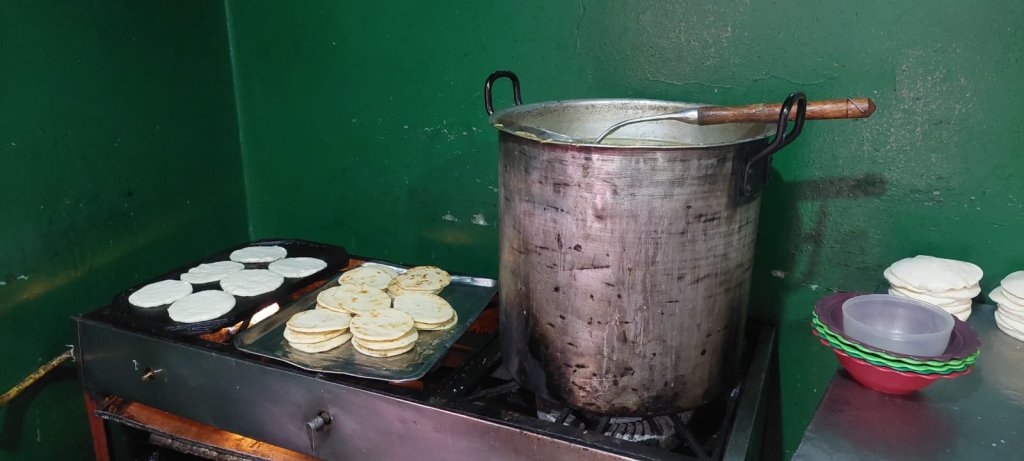
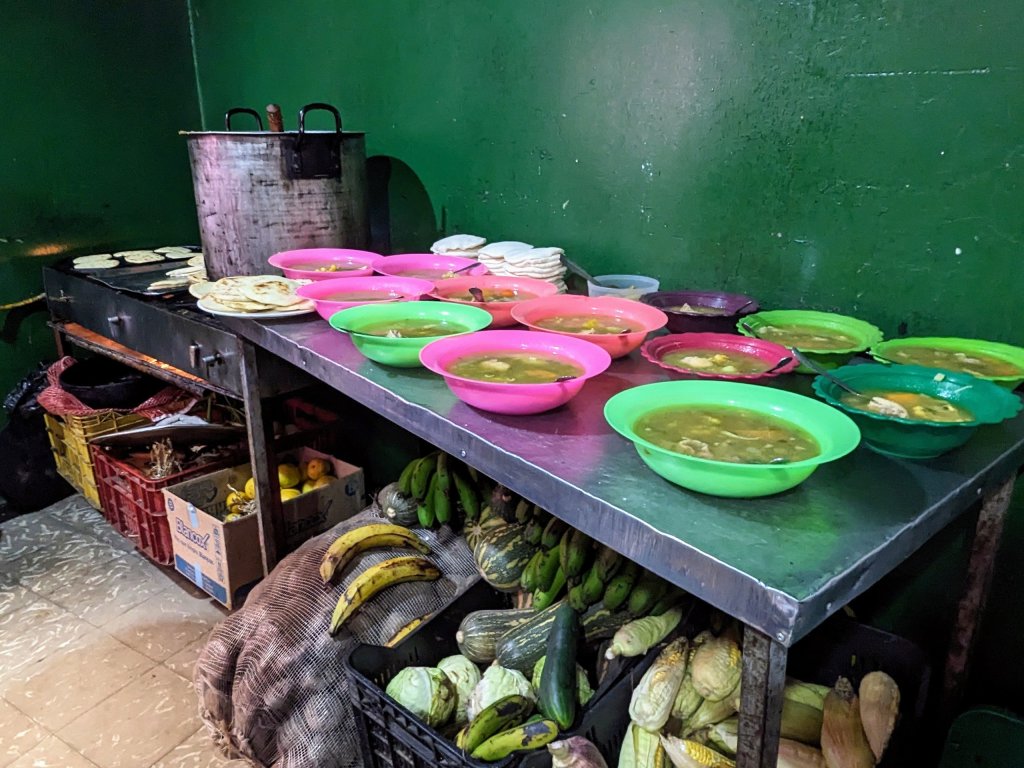
As the room downstairs filled, we began filling bowls with the rich stew, adjusting quantity as messages of caminante numbers floated up from the main level. Maritza gave command to begin food service, and my bad-stair feelings resurfaced. I grabbed a couple servings of soup, playing hot potatoes with my fingers on the scalding bottoms of the bowls while I wound my way through the multiple volunteers and kids making their way up and down the staircase just wide enough for one set of shoulders.
Twenty-three bowls – six of a smaller portion for the children – made it down the stairs without casualty, and I breathed a sigh of relief.
“Ay! La limonada!” Maritza turned toward the forgotten pitcher of lemonade. We poured sixteen glasses of super sweet confection, arranging them carefully on a silver-colored platter. I gulped back a rush of fear when Mari ordered me to carry the precarious load down the stairs.
I hefted the sloshing salver, testing the load and hugging it close to my belly, calling out my approach as I neared the stairwell. I felt out each stair with one foot, testing its security before reaching out the second foot to meet it. My tensed shoulders dropped a few centimeters when I reached the bottom floor, and I turned the sharp corner into the hallway toward the makeshift dining room.
Mmmmfff. My eyes flew wide, heart racing. The cups on the platter trembled, their contents careening wildly at the rims. The narrow hallway was wide enough for shoulders, but not for a platter and the white knuckles tucked alongside, especially with the momentum of a harried waitress motoring behind. I backed slowly away from the platter-turned-restraint, dislodging my knuckles from the walls as I turned the tray lengthwise, gliding without breathing around the final corner.
I can only hope the caminantes felt as much relief as I did when they received their refreshments.
I grabbed a bowl of soup for my lunch and found a spot at the table of shelter workers and their children. I stumbled through Spanish greetings and pleasantries, introducing myself as a physical therapist. One worker lit up – perhaps I could take some time to examine her daughter, Antonela. The group moved en masse around the corner, encircling a seven-year-old girl with a huge smile barely contained by her slight frame. An exceptionally eager 8-year-old grabbed Antonela by the armpits, heaving her to her feet and dragging her across the tile floor until space ran out (about 1 meter). The group watched her face, shouting encouragement; I watched her legs: feet turned aggressively inward, legs stretched rigidly into extension with the ankles crossed, minimal volitional control. All signs pointed toward spastic paraplegia: a neurological condition plaguing the lower body with weakness and reflexive muscle stiffness. “Sí,” mother Stefany confirmed; Antonela had been this way since birth.
My Spanish skills limited my ability to delve into the cause, but my brief pediatric training from a decade previous suggested possible spina bifida or other spinal cord defect since Antonela appeared to have normal strength and movement above the waist. My confidence plummeted – I don’t have experience with neuro pediatrics! I don’t have the skills to best help this little girl! I can’t give the best care!
…but I can give my best.
I wrestled against my inner self-deprecation, barely subduing it as I quickly searched for a picture of ankle-foot orthoses on my phone. I flashed the image to Stefany, who jumped to her bag in the corner to retrieve custom orthotics for Antonela’s twisted ankles. “Perfect!” I cried, not bothering to add the -o suffix or accent to convert the word to a Spanish-speaker’s liking. We slipped knee-high socks and the rigid braces onto Antonela’s legs, using the straps to firmly hold her feet in a more neutral alignment. The group hefted her to her feet again, dragging her helpless legs behind her. I struggled to call them to order — mostly because my thoughts refused to comply to order as well.
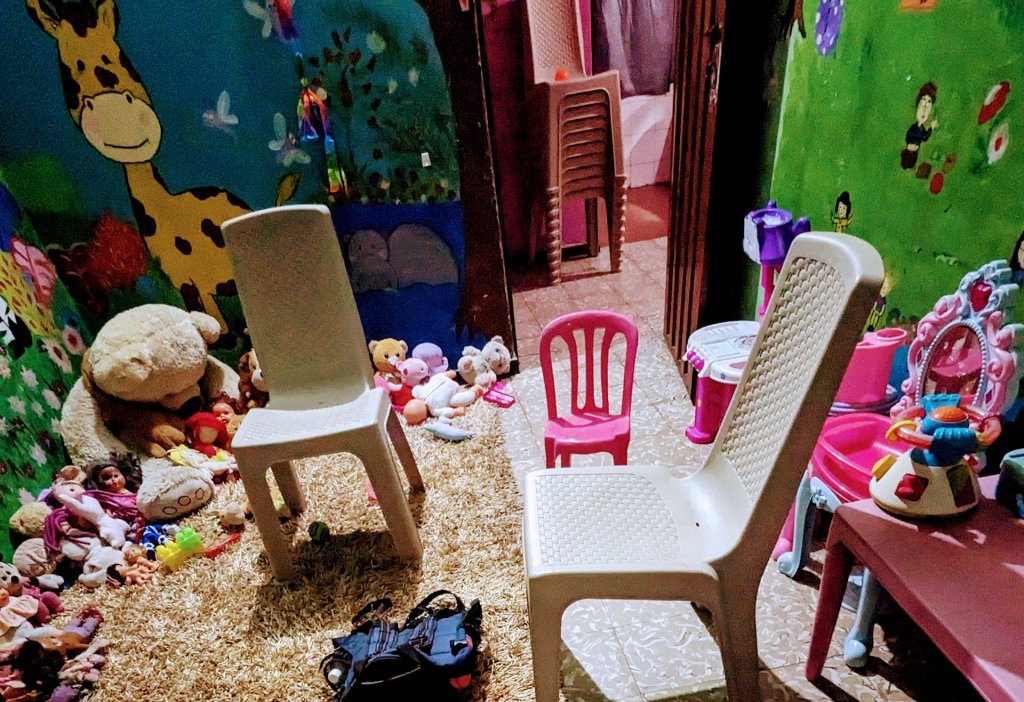
We moved to the children’s playroom for some quiet, volunteer Jo accompanying us to help with Spanish interpretation. I gently stretched Antonela’s legs, evaluating whether her joints had grown stiff in the prison her muscles imposed. Jo and Stefany were called back to work, and I continued on with the eager 8-year-old and Antonela, trying in vain to see her hold various sitting and standing positions as the over-helpful 8-year-old pulled out balls and dolls and lollipops, thrusting them enthusiastically toward Antonela, to her great delight.
Frustrated with myself for my lack of ability, I slumped among the stuffed animals and wheeled toys and sighed. I was not up to this task. I wasn’t helping. I couldn’t heal this little girl, nor help her mother; I couldn’t even cut a potato for the soup. What was I doing here in a place with so much hurt and need, unable to offer a solution? Was I simply in the way, others scurrying past in their duties but placating me in my wish to feel like I could make a difference? How could I believe that I had a right to try?
Antonela smiled her huge smile, flashing a glance at me as she bounced exuberantly on her precarious physioball perch. I steadied the ball with a practiced hand, guarding her against a fall to the tiled floor. I allowed myself a tiny grin, watching her unfettered joy and her utter disregard for my insufficiency.
Maritza poked her head into the room; there were still dishes to be washed. I clambered to my feet after helping Antonela to a more stable seated position on the floor, then scurried to the kitchen to once again prove my ability to do things poorly, but with a willing spirit. That gargantuan soup pot, sooty from the gas flame, swallowed my arm to the shoulder joint as I reached in to scrub away the last clinging bits of sopa. Mari stepped in to show me how to finish, with a firm, “Ya. Ya!” as I continued scrubbing. She finally realized my misinterpretation of her approval of completion, gently grabbing my wrist and saying, “Termina.” It’s finished.
And I remembered Someone else who covered my insufficiencies with the declaration of, “It is finished.”
 Conversations on El Camino