“Relájese y respire,” the woman in the queue instructed my current client, modeling the desired deep breathing technique intended to induce relaxation. They breathed deeply together, synchronizing and slowing their breathing, faces melting into smiles. “Respire Dios en la alma; Dios puede sanarle” — breathe God into your heart; God can heal you.
I paused my instruction, observing that the lesson in how to deal with stress-induced neck and shoulder pain was already being taught.
We were well into the afternoon of our first day of clinics in Cusco, beginning a week of medical care organized by CHG’s Making a Difference Foundation and A Broader View Volunteers, partnering with Marathon Health. That morning, ten medical providers with an auxiliary administrative volunteer and a half-dozen interpreters had stepped off the mini-bus in Wanchaq, unsure of what to expect. We walked into the educational complex and saw wooden benches and chairs lined up in the courtyard, held down by no fewer than 75 persons of various ages and capabilities, all waiting for their chance at healthcare usually outside of their reach.
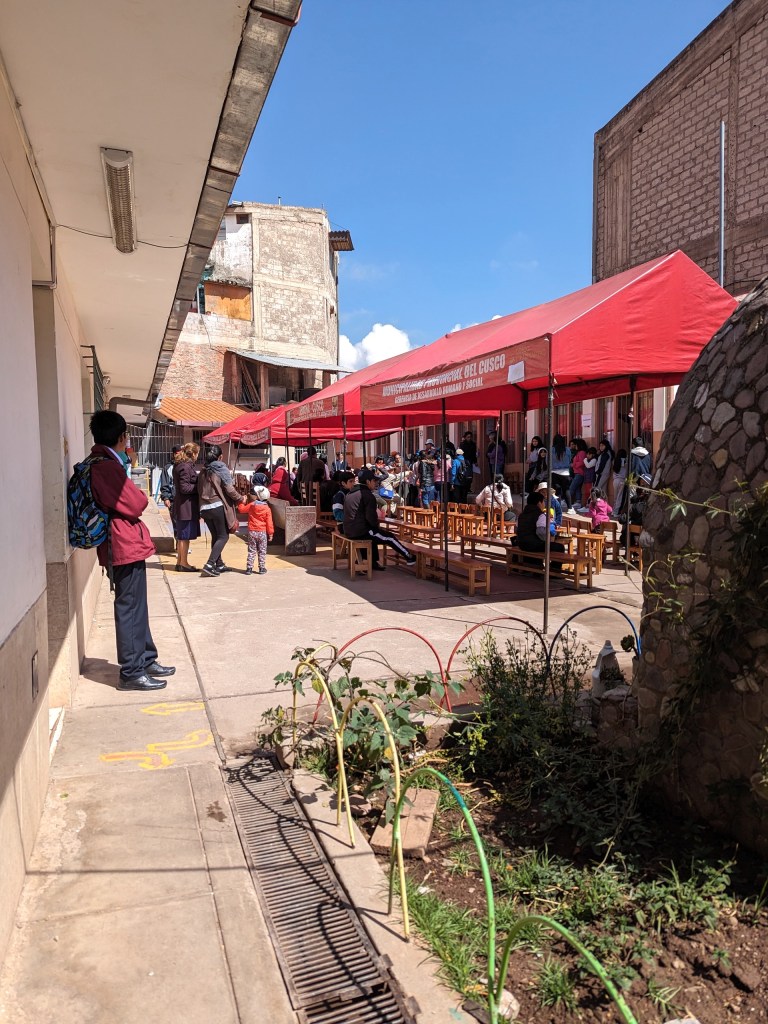
We hauled suitcases of medications, splints, resistance bands, and eyeglasses – all sorted the night before in a sea of chaos on Maria Elena’s living room floor – setting up our respective stations in rooms as indicated by our coordinator. Heather and I set up our PT room with a single waist-high bed table and foam mat, preschool-sized desks slid against the walls. We had a slow start in the PT department as patients worked their way through triage and medical providers, but soon a line of eager patients tracked outside the door and along the wall.
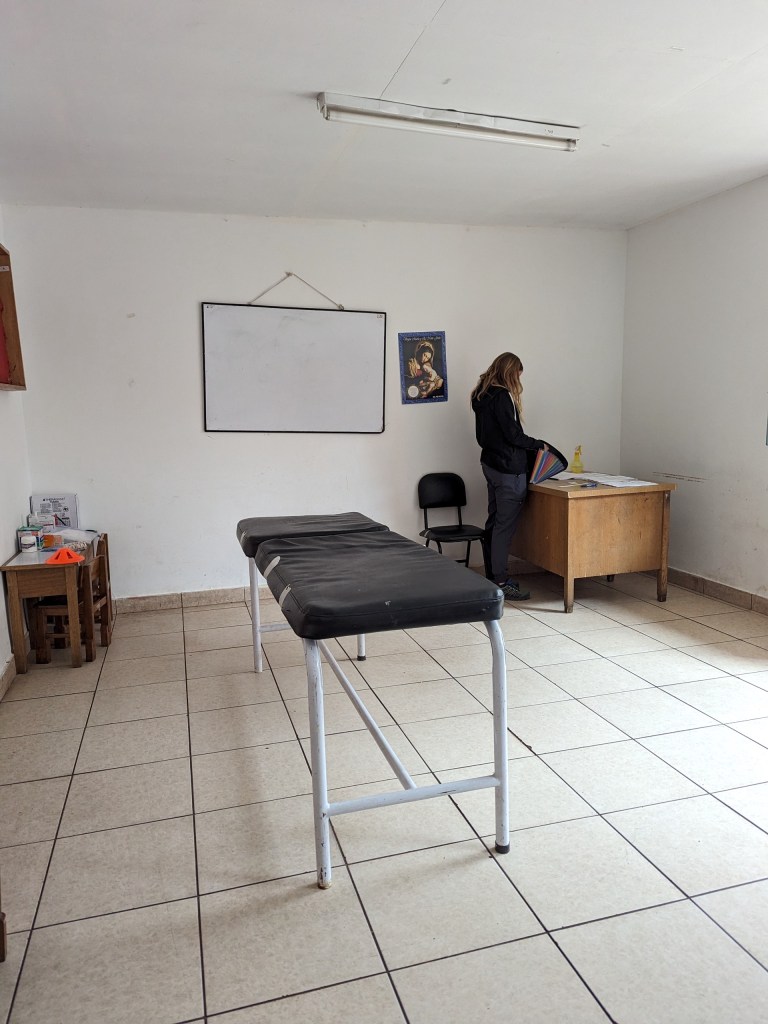
Muchos dolores walked through the door: headaches, neck pain, shoulder complaints, knee pain, nerve conditions. I dove into a crash course in medical Spanish, knocking off rust as I asked about dolor de la cabeza and músculos apretados, dancing and gesturing wildly as I exhausted my positional vocabulary of stand up, sit down, and over there. Our interpreter Adriana somehow listened to two conversations simultaneously, piping in cheerfully whenever a patient and I stared at each other blankly for a beat too long, otherwise attending to Heather and her client. As soon as one patient was sent out with their exercise instructions, another sat in the seat (desk – chairs were hard to come by) still warm from its previous occupant. We continued at this pace for hours until the coordinator came and escorted/carried us off the premises at 2:00pm for lunch.
Our huge lunch of chicken, potatoes, rice, and Inca Kola sustained us until our proposed closing time of 5:00p… 5:30p… 6:00p when we finally turned those remaining in line away until tomorrow.
When we stepped off the bus the next morning, the line of patients stretched out the front door, along the sidewalk, and around the corner of the building. Easily numbering 100, they erupted into cheers and applause as we wove our way through the crowd and to our stations. We grew more efficient and I grew more confident in my Spanish, even tackling some more heady topics like causes of osteoarthritis and disc hernations. Here’s hoping that the word for oil is the same in the kitchen and in the small engine shop; otherwise there’s a few dozen Peruanos who are rubbing cooking oil on their aching knees instead of just going for a walk.
At the close of our second day in Wanchaq, over 500 clients had been triaged, with 88 receiving physical therapy treatment — double our anticipated numbers. Weary but cheery, we relaxed with a night of cultural food and dance at a restaurant on the main plaza in Cusco, celebrating the coalescence of a team gathered from across the Americas, united by a desire to serve.
 Conversations on El Camino