5,895 meters.
19,341 feet.
The highest peak on the continent of Africa.
The tallest free-standing mountain in the world.
And I had the privilege of standing on top of it.
It’s been one week since I came off the mountain, and I’m still processing. Nine months of planning, training, shopping, packing (so much packing!), arranging, anticipating; all culminating in eight days of dancing with a mountain.
It’s been profoundly difficult to distill this experience into words. My body holds the memory of not just slippery, muddy, uneven terrain, but also an internal sea teeming with seemingly contradictory emotions:
I’m exhausted.
I’m thrilled.
I’m overwhelmed.
I’m content.
I’m unsettled.
I’m in disbelief.
But mostly, I’m grateful.
5:44 am. March 12, 2026.
We were 6.5 hours into our hike – cold, dark, trudging drudgery. The sintered snow on slippery scree forced us to place each footstep carefully, some steps sliding back down the slope and stealing precious energy. The air grew thinner – we were nearing 19,000 feet, where atmospheric pressure is so low that each breath discharges only half of the oxygen picked up at sea level. Our slow trudge up the scree slope matched the cadence of a funeral march, our “pole pole” (POH-lay POH-lay) footsteps falling once each second, punctuated by pursed-lip breathing, sniffles, and coughs.
Our guides had wisely called for a short break. We collapsed onto rocks and snow patches close to the trail; hiking off to the side took too much energy and shortness of breath was quick to set in. “Maji maji” was the call – “water, water”. We dutifully took draughts from our inverted Nalgene bottles, stored upside-down to minimize risk of ice forming on top and blocking access to fluid. The guides wove their way between us, offering sips of a mystery cocktail mixed from two bottles in an insulated steel mug.
I was verifiably miserable. My head hurt, I was tired and cold, doped up on Immodium to slow down my bowels (squatting to poop behind a rock three times in an hour is exhausting).
But then…
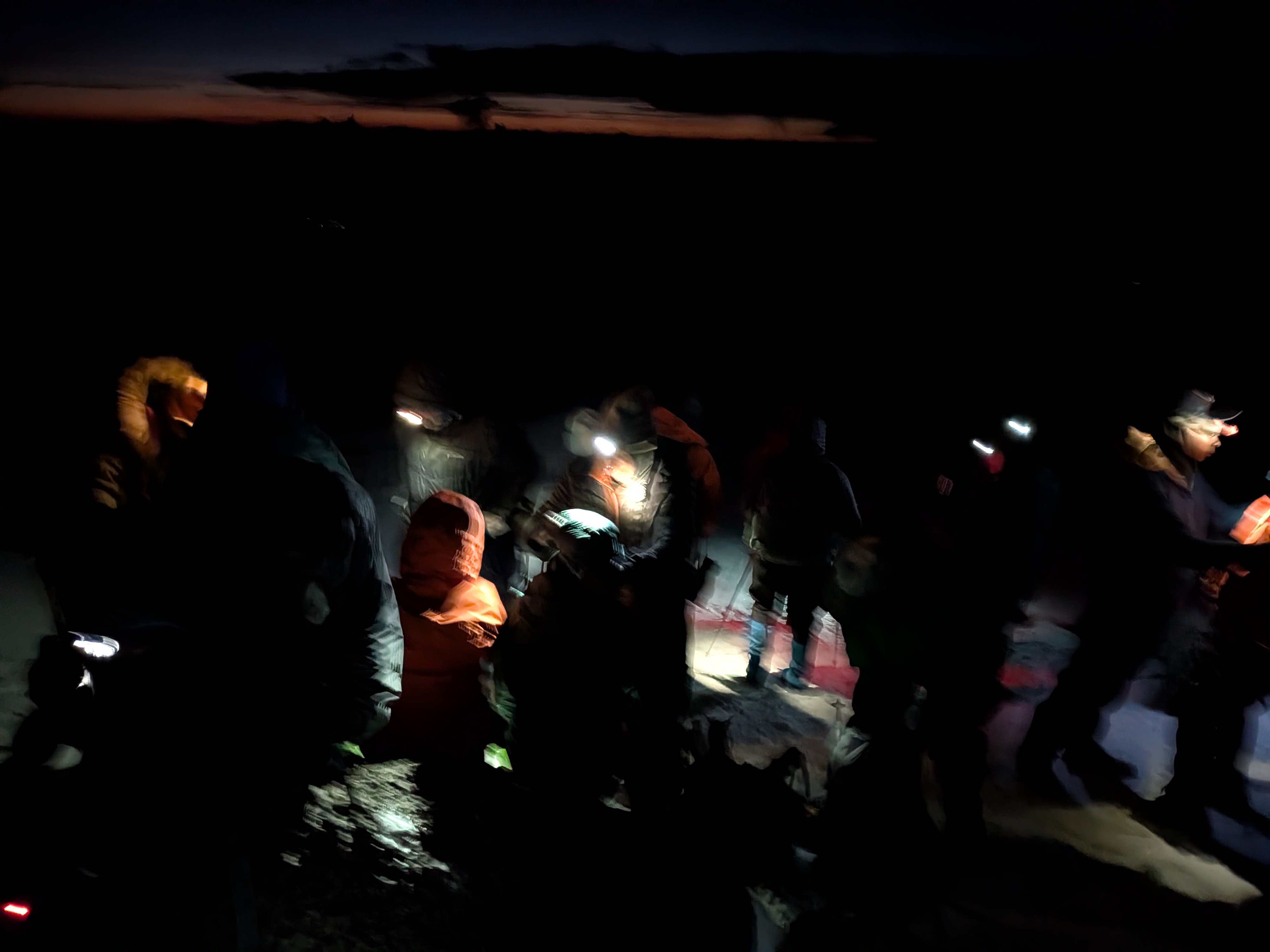
The horizon had the faintest hint of orangey-pink. Dawn was breaking. The long night was nearly over. We picked up packs and poles and turned uphill once more. My mind’s ear played a song I sang as a very little girl, taught to me by my mother:
Look who’s coming up over the hill
Emma Lee Benedict
Look who’s shining on my windowsill
With the blue birds singing and the blue bells ringing
It’s morning again!
I cried with gratitude.
Of all the mountains I’ve climbed, and all the things I’ve done, one theme emerges: For every hard thing, every accomplishment, I have been surrounded by helpers. I’ve done nothing truly independently.
I looked ahead and behind, in disbelief that I was included in a line-up of such amazing human beings. I thought of my cheerleaders off the mountain, a world away, who believed in me even before I could. Each arduous step was a testament to the “cloud of witnesses” cheering for my success.
I wept and sniffled my way up the next 500 feet of elevation, exhausted and grateful. We reached Stella Point at 6:30 am, the sky widening into oranges and blues as we crested the rim of the volcanic crater. An hour later, we stood atop Uhuru Peak: hugging, crying, and panting, lips blue from cold and low oxygen. Standing on the Roof of Africa, proving what one kidney can do. Celebrating World Kidney Day in high fashion, as a crew of individuals who have the distinct privilege of celebrating simultaneously on two continents (we reserve the right to celebrate World Kidney Day wherever our kidneys reside).
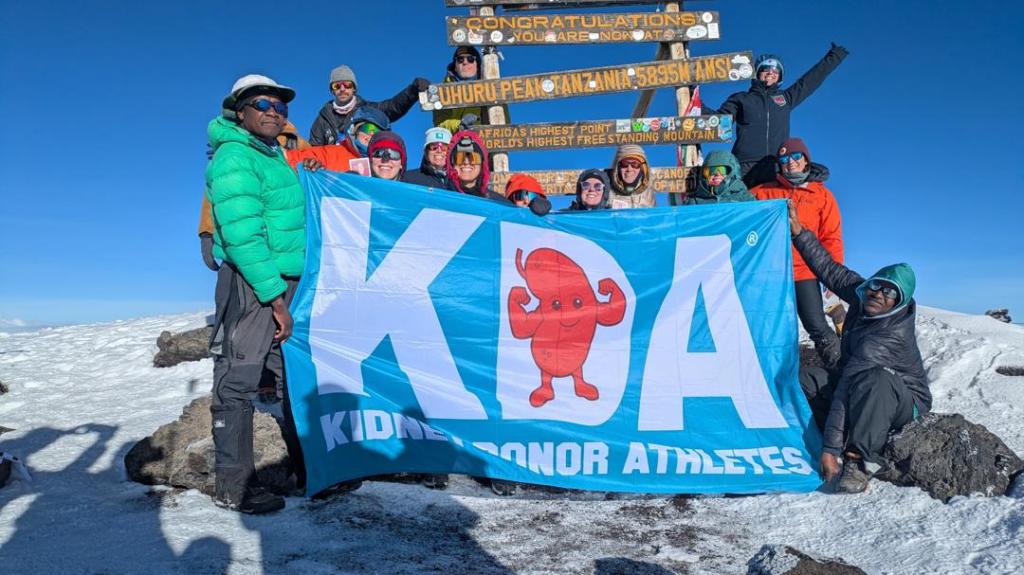
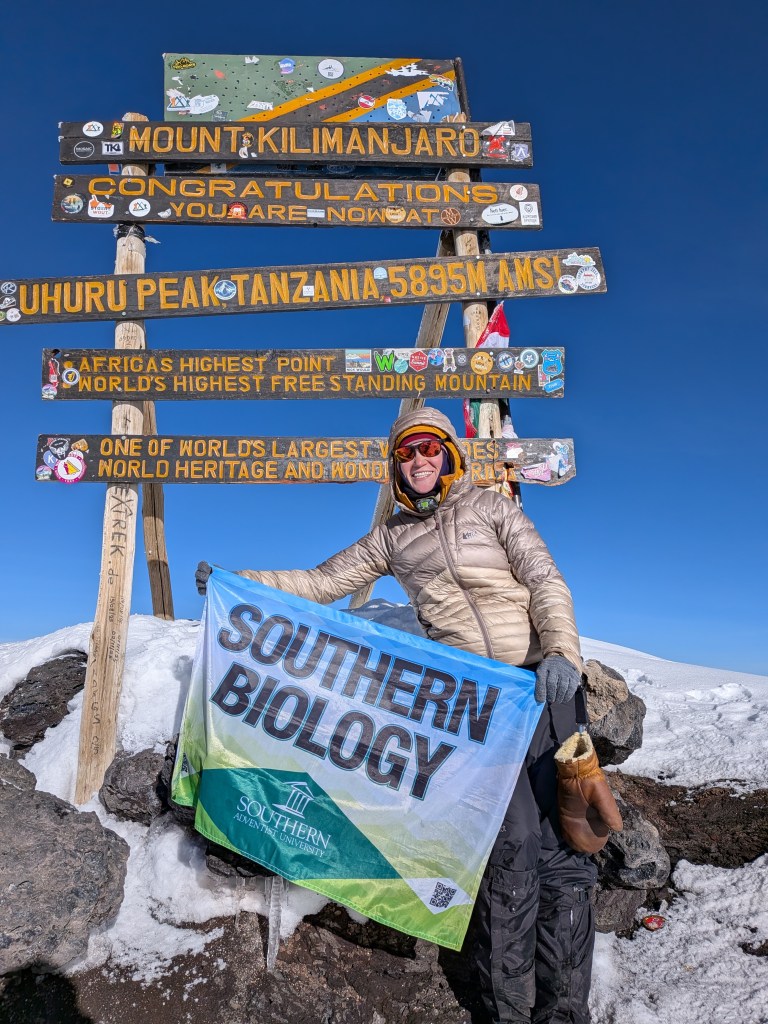
Never once was I alone in this mountain climb. I did it surrounded by helpers:
- Fourteen amazing living kidney donors: strangers turned family. Each one of them has just one healthy kidney and a heart of gold.
- Sixty-six (YEP – it was an army) guides, porters, cooks, and encouragers who removed every barrier. All I had to do was eat, sleep, and hike.
- Fifty-seven generous donors who invested not only hope and time, but also funds. Funds to support the Kidney Donor Athletes‘ initiative to spread the word: donating a kidney to save another’s life doesn’t diminish the donor’s life in the least. I’d argue that my life is bigger, richer, and better after donating my kidney in April 2024.
- Countless voices of cheerleaders and well-wishers who took the time to cheer us on.
There is so much to unpack from this immense undertaking (Heck, it took me two full days to unpack my duffel bag and get everything cleaned up and stashed away). I plan to share more here as thoughts settle into words. It might take longer than I’d planned. I suppose that’s my cue to embrace “pole pole” – slowly, slowly. It’s the only way to climb a mountain, I’ve learned.
I’m still processing.
But mostly, I’m grateful.
Asante sana.
Thank you.
💚🇹🇿💙
 Conversations on El Camino
Great news! Congratulations on meeting this substantial challenge and welcome back to an oxygen-rich zone. Looking forward to hearing more.
LikeLike
Most hearty Congratulations, grasshopper, you have arrived.
LikeLike