And now we’ve reached Forgetful Times with Jessica, the part of the journey where she has to look at her photos to remember what she did 2 days ago.
Keeping up with blogging is a whole different ball game in a small bus-home shared with two kids under three, and when there’s so much to do and see during the day!
After my heifer greetings on Monday morning, we cruised (and bounced) to the Blue Spring, where we trekked for 5 km along a crystal clear, teal-tinged stream that boasts much of New Zealand’s bottled water supply. We spotted paradise ducks, eastern rosella, a shag, and plenty of sheep and cattle. In true fashion, I took an average of 200 photos per hour. Photo management has been a part-time job throughout this trip!

Wairere Falls and some rock jumping was next. Darren was much more daring than I, especially as I reinforced the “Falls” portion of the name with a slip of my own (only ego injured).

Tuesday brought clouds and cold, but we were headed to the beach. We hiked down the coastline to soak in some sand and surf. I was BLOWN AWAY. Cathedral Cove was on my (ever-growing) list of places to see during my time here, and it was well worth the hype. God makes such neat things!

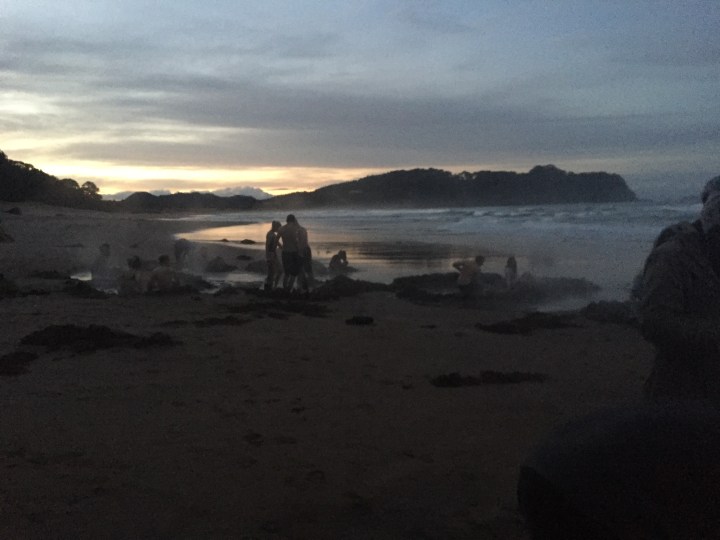
A few kilometers down the coast from Cathedral Cove is Hot Water Beach, which offers its neatest feature at low tide, which was 8pm on Tuesday. At this location, a hot spring runs under the surface of the sand before emptying into the sea. By walking about on the sand and noting hot spots, you can dig a hole in the beach for the water to empty into, modulating the heat much like a tap, by letting more hot or more cold water to fill the bath. I was amazed at the temperature gradient between just a few inches: one foot hot, the other cold. We allowed ourselves a spa treatment in the chill evening air, lacking only candlelight and jazz music (ocean waves are way better anyway, even when they dump cold – er, refreshing – water into your bath). This was an experience all its own!
Camping spots are at a premium cost on the Coromandel Peninsula, so we opted to drive into the night to camp at the next day’s adventure site, Dickey Flat. We awoke to sunshine and birdsongs and hiked through an old manmade water tunnel (and under more glow worms!) to a lovely cascade.


Let’s be real: Jessica is disturbed by things that go bump in the dark.
So what did we do next? Walked through more dark spots (Jess was equipped with her head “torch” on this round).
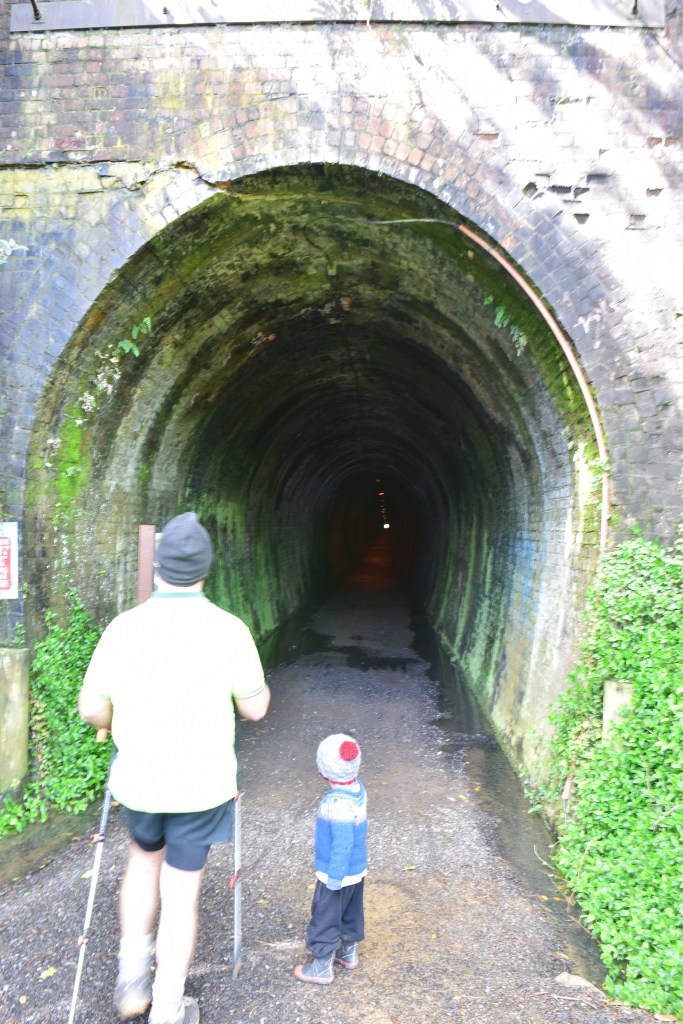
We then chased the light at end of the Karangahake tunnel, an old railway track built 1900-1905 that cut through the mountain. The light never seemed to get any closer, so we walked and walked and walked and walked…over 1 km! What a feat of engineering.
The track (trail) continued for nearly 5 km following the Waitawheta and Ohinemuri Rivers in the Waitawheta Gorge; lovely views! How refreshing to stroll along a boiling, clear river, walking in and out of the shadows of the steep, lichened cliffs. We also ducked in and out of old gold mining shafts, with “windows” peeking out into the gorge and over the river. I was thankful that I am not a miner; what a job!
Throughout our hike, I was reminded by my 2-year-old handholder of the potential awe of each stone, each blade of grass, each leaf, and especially each drainage culvert. Our andante hike was both an exercise in patience and in revelry. 😉

On Thursday, we awoke to the crowing of roosters at our roadside rest area camping spot. When visiting New Zealand, don’t worry about visiting a farm to see local fowl; just pull over on the side of the road! Apparently, rest areas are the hot spot to “lose” your unwanted fowl. There was also a flock of drakes wandering about the bus as we ate our breakfast of hot porridge.
Next was a trip to the gold mining museum in Waihi. This region was the 3rd-largest producer of gold in New Zealand in its heydey, but in a much more labor-intensive manner than gold veins or nuggets, or even panning gold dust from the river. These gold miners hacked chunks of quartz from deep in the hills, pounded it to a powder with steam-operated steel battering rams, soaked it in cyanide, and passed the sludge through zinc plating to extract gold and silver ore. Those hearty New Zealand miners earned themselves a solid reputation; look up the Battle of Arras to gawk at their World War I exploits.
After a stop at the open pit Martha Mine (a really big hole in the ground), we drove on to the shopping plaza in Tauranga to do some shopping at an outdoor store. Jessica drooled over all the merino wool garments and was tempted by the end of season sales, but exhibited astounding resolve and exited the store with her money still in her pocket (though that night she was still dreaming of a replacement for her nearly 20-year-old sleeping bag when she awoke in blustery 40 degree temps with cold toes).
Now it’s a blue-skied Friday, and we’re back on the road after a breakfast of crumpets and jam, headed to Rotorua for hot water springs, laundry, and bathing – hallelujah!
**~**~**~**~**
Postscript:
At Blue Springs, there was a small memorial with a poem that reminded me why I came to NZ in the first place:
DUST IF YOU MUST – Rose Milligan, author
Dust if you must, but wouldn’t it be better
To paint a picture, or write a letter
Bake a cake, or plant a seed
Ponder the difference between want and need
Dust if you must, but the world’s out there
With the sun in your eyes, the wind in your hair
A flutter of snow, a shower of rain
This day will not come around again
Dust if you must, but there’s not much time
With rivers to swim and mountains to climb
Music to hear and books to read
Friends to cherish and life to lead
Dust if you must, but bear in mind
The time will come and it’s not kind
And when you go, and go you must
You yourself will make more dust
 Conversations on El Camino
Vicariously living your travels. What a treasure of memories. New Zealand sounds amazing.
LikeLike